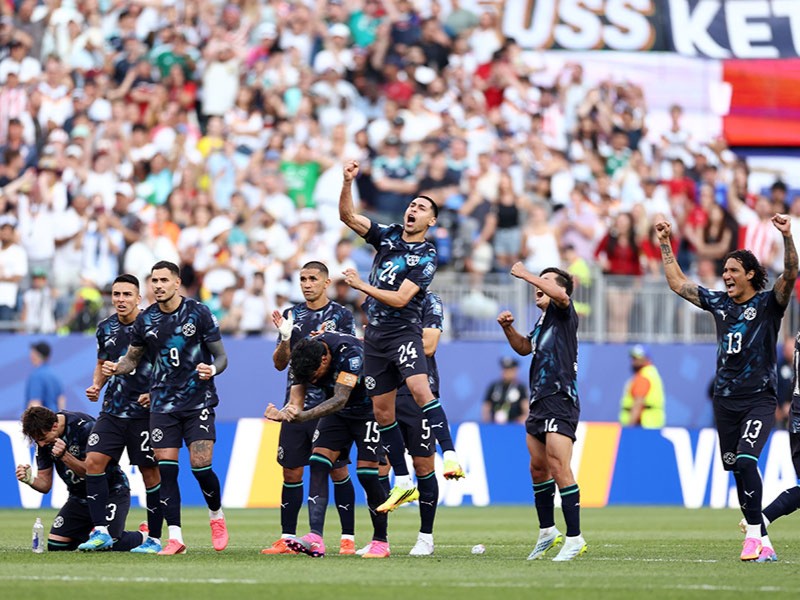
For more than four decades, Uli Stielike carried the distinction of being the only German man to miss a penalty in a World Cup shootout. That record disappeared dramatically as Germany suffered three misses in one decisive contest. Kai Havertz failed with a weak effort, Nick Woltemade’s attempt was also comfortably saved, and Jonathan Tah blasted his kick over the crossbar before Jose Canale converted the penalty that ended Germany’s campaign.
The outcome added another chapter to a sequence of tournament disappointments that has transformed perceptions of German football. Once regarded as the side that always found a way through knockout football, Germany have now failed to reach the last 16 in three consecutive World Cups. Their most recent victory in a knockout match at the competition remains the triumph in the 2014 final.
Since lifting the trophy, Germany has suffered elimination either during regulation time or after penalties against Mexico, South Korea, Japan, Ecuador, and now Paraguay. Before this match, many within German football expected a difficult test against France in Philadelphia, but those plans never materialised. Paraguay claimed the place in the next round instead, leaving Germany heading home far earlier than anticipated.
Nagelsmann’s future surrounded by uncertainty
Julian Nagelsmann admitted during the tournament that he would welcome the opportunity to remain in charge, yet this latest setback appears likely to place his future in serious doubt. Throughout the competition, Jurgen Klopp was present as a television pundit, with speculation growing that the former Borussia Dortmund and Liverpool manager could eventually become Germany’s next head coach.
Nagelsmann’s spell with the national team may ultimately be remembered as one that promised much without delivering lasting success. Germany opened Euro 2024 with a commanding 5-1 victory over Scotland before reaching the quarterfinals, while this World Cup began with an emphatic 7-1 win over Curaçao. In both tournaments, however, the encouraging starts gradually faded.
Performances in the United States were never fully convincing against stronger opposition. Germany narrowly defeated Cote d’Ivoire, then lost to Ecuador in a match where several players admitted their opponents showed greater desire. Against Paraguay they controlled possession and created opportunities but managed only a single goal across 120 minutes. Jonathan Tah had another effort ruled out, a decision that may have been incorrect, yet Germany’s overall display left too many weaknesses to blame their exit solely on bad fortune.
Selection calls fail to deliver
One of Nagelsmann’s most debated decisions was persuading Manuel Neuer to return from international retirement. The experienced goalkeeper appeared every bit of his 40 years, particularly during the defeat to Ecuador, while continued faith in Leroy Sane also failed to produce the desired impact.
Sane had once been overlooked by Joachim Low before the 2018 World Cup despite possessing explosive pace, but Nagelsmann made him a starter in every match. Although the winger scored after only two minutes against Ecuador, he endured a miserable outing versus Paraguay, surrendering possession 23 times and failing to complete any of his seven dribble attempts.
Questions also surrounded the handling of Jamal Musiala and Deniz Undav. Musiala started on the bench, while Undav earned criticism for initially being left out despite producing three goals and two assists from his first two substitute appearances, lasting only 56 minutes in total. Yet when Undav was finally selected from the beginning against Paraguay, he struggled to influence the game, and Germany lost the impact he had previously provided as a substitute.
Injuries and deeper concerns shape another disappointment
Nagelsmann also had legitimate reasons to point toward the squad’s limitations. Injuries ruled both Lennart Karl and Serge Gnabry out before the tournament, reducing his attacking options. Florian Wirtz endured a difficult first season at Liverpool, while Woltemade’s debut campaign at Newcastle proved equally disappointing. Without Karl and Gnabry, Germany never appeared to settle on a consistent attacking formula, and much of their impressive scoring record stemmed from the heavy victory over Curacao.
Beyond personnel issues, broader questions continue to emerge. One suggestion is that Germany’s increasing emphasis on possession football, influenced in part by former Bayern Munich coach Pep Guardiola, has weakened qualities that once defined the national side. While the current squad possesses technical ability, it has been argued that it lacks the authority and relentless mentality associated with previous generations. There are numerous creative players capable of operating as a number 10, yet since Miroslav Klose, there has been no long-term, traditional German centre-forward.
Another possibility is that the overall standard of international football has risen significantly, making teams outside the traditional elite much stronger than in previous decades. Even so, Germany still expects to overcome opponents such as Paraguay. Havertz described the elimination as a shock, but as Germany failed to score the decisive second goal, there was an increasing feeling that their flawless World Cup penalty shootout record might finally disappear. The nation once renowned for consistently surviving the biggest occasions became the first major heavyweight to leave the tournament, a result that reflects how dramatically its World Cup identity has changed.